
Commercial leadership for property and PropTech businesses. More revenue from the sales, marketing and technology you already have.
[email protected]You built the product. Now you need the business to work.
You might be a brilliant founder, developer or product person. That does not mean you should automatically know how to price it, sell it, structure the team, manage performance or build the processes around it.
I work with PropTech founders, owners and directors to see where the business is dropping the ball, work out what needs to change and help put it right.
The aim is simple: more revenue, better return from the leads and customers you already have, and a business that does not depend on one person to keep everything moving.
A sale is only one part of it.
I want to understand what happens from the moment somebody first hears about you through to the point where they renew, buy more or leave.
That means looking at things such as:
Where do opportunities come from? Who follows them up? What gets a meeting? What happens afterwards? What converts and what gets lost?
What are customers paying, why are they paying it and is the price still right for the value and cost of delivering the product?
Who owns what? What is expected of them? How is performance measured? Is too much knowledge or responsibility sitting with the founder or one experienced person?
What happens after they sign? How quickly do they get live and actually using it? Who notices when a customer goes quiet — and do you know why people leave?
What are customers actually asking for? What are they willing to pay for? Which requests are worth development time and which are simply noise?
How does work move between sales, product, onboarding, support and account management? Where does it stop, get repeated or rely on somebody remembering to do it?
You may already have the leads, customers, people and products you need, but is the business getting enough from them?
In my experience, it comes down to improving conversion, getting customers live and billable faster, changing the way you price, building better account management or making sure development time is going into things customers actually value and will pay for.
It means giving the sales team clear expectations and the information they need, so you are not stepping back in every week.
What matters is knowing where the opportunities are and which one to focus on first. I look at the numbers, the process and what people are doing day to day, then we decide what is worth changing first and what difference it should make.

Many founder-led PropTech businesses reach a point where too much still relies on what one or two people know. The founder knows which prospects are worth pursuing, how to handle objections, when to flex on price, which customers need attention and which product requests are worth listening to. That can work while the business is small, but it becomes harder as the team grows.
Part of my role is to get that knowledge out of people’s heads and into the business, with clearer roles, expectations, processes and measures so other people can do the job properly without everything coming back to the founder.
The aim is not to remove the founder from the business. It is to stop them having to be involved in every sale, customer issue or operational decision.
Yes.
You do not need to turn yourself into a salesperson.
We need to understand what currently works when you are involved, decide what should be repeatable and build a team and process that can do more of it without you.
Yes. The first question is not whether you need different salespeople. It is whether the people you already have have been given what they need to perform.
I would look at expectations, targets, activity, conversion, how the product is being sold, management, follow-up and the numbers behind it before deciding what needs to change.
We need to understand what customers pay now, what different customers are worth, the value the product creates for them.
Yes.
I start by looking at onboarding, product use, account management, retention, additional products, pricing or when and how customers are approached.
For an established PropTech business, the existing customer base can be as important as new customer acquisition.
Enough to see what is happening and make decisions.
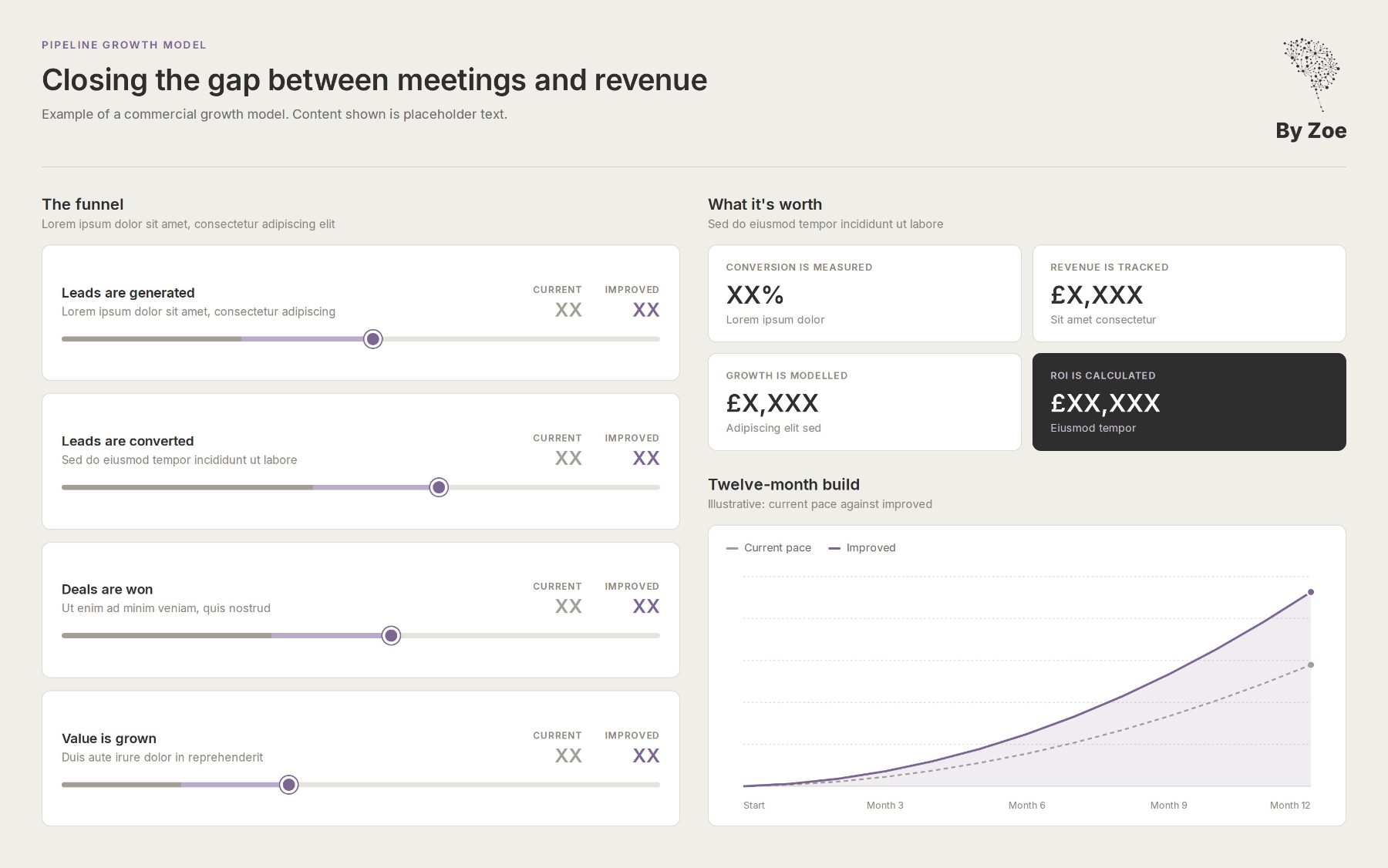
That normally starts with the path from opportunity to revenue: leads, meetings, proposals, sales, conversion, value, time to close, customer value, retention and reasons for loss.
The exact measures depend on how your business sells and makes money.
Yes.
That can include roles, responsibilities, management expectations, sales process, onboarding, account management, reporting and the hand-offs between teams.
The point is not to create layers of process for the sake of it. It is to make it clear who does what and how you know it is working.
Let’s look at what is happening between the product, the customer and the sale together.
Book a conversationThis site can use Google Analytics to count visits and see which pages get read. Nothing is stored on your device unless you agree. How the data is used